There’s a question that gets pulled out at dinner parties, workshops, and well-meaning conversations. You know the one. If money were no object, if you couldn’t fail, if the whole world were open to you – what would you do?
“What do I want?” sounds like it should be the easiest question in the world. For a long time, it was.
When I was a kid, I could have answered that without pausing for breath. The list was long, and I meant all of it. But somewhere between the responsibilities and the mortgage and the family and the work and the general accumulation of a life well-lived, the list got shorter. Then hazier. Then one day I asked myself the question and found I genuinely couldn’t answer it. The wanting had gone quiet and disappeared … and I hadn’t even noticed it leaving.
These days, when I sit with the question, one thing does surface: travel. Which is interesting, because I never did the big trips in my twenties – no backpacking across Europe, no African adventure, no finding-myself summer. I don’t regret that; my life went other ways and I chose it. But somewhere underneath the daily routine, there’s clearly a pull toward something; toward history, toward culture, toward being immersed in a place that has a story I don’t know yet. When I pull on that thread, what I find isn’t really wanderlust. It’s curiosity. A hunger to keep learning.
Which tells me the wanting is still in there. It’s just been waiting for me to get quiet enough to hear it.
The haze sets in gradually
It doesn’t happen in a single moment, the losing track of what you want. For me, it made sense. I got married and had a child in my late twenties, and life quite naturally became about we – about what we needed, what worked for us, what was best for everyone. And there’s nothing wrong with that. I was doing exactly what the season called for.
But somewhere in all of that, the I got quietly folded away. Not because anyone asked me to, but because it was easier, or kinder, or there just wasn’t room. The question what do I want started to feel almost foreign, like a language I used to speak fluently and had slowly, quietly forgotten.
It’s only in my forties, with a bit more space and perspective, that I’ve been able to step back and think in a more … selfish way. I mean that as a good thing. Thinking about what I want, separate from what works for everyone else, feels almost radical after so long. But it’s also, I’m realising, necessary.
What goes missing when desire goes quiet
Here’s what I’ve come to understand: wanting things – even small things, even ordinary things – is not a luxury. It’s actually part of how we orient ourselves in the world. Desire is directional. It points us somewhere. And when we lose touch with it, we don’t just feel vaguely flat. We lose a source of forward momentum.
Think about the last time you were genuinely looking forward to something you’d chosen for yourself. Not a family holiday you’d organised, not a work milestone, not something you were proud of on behalf of someone else – something that was just for you. Remember the low hum of anticipation? That’s energy.
When desire goes quiet, that hum goes with it. And we often don’t connect the dots. We think we’re tired because of hormones, or sleep, or the relentlessness of midlife’s mental load – and yes, all of those things are real. But sometimes the flatness has another layer to it. The layer that comes from running on obligation and routine and everyone else’s agenda, with very little of your own want in the mix.
Why it takes so long to notice
For a long time, I didn’t even realise the haze had settled. Because the life I was living wasn’t a bad one; it was full and busy and meaningful. When you’re in the thick of raising children and building a career and keeping everything running, there isn’t a lot of space to notice what’s missing. You’re not unhappy exactly. You’re just … occupied.
And that’s the thing about this particular kind of loss. It doesn’t announce itself. There’s no moment where you think oh, I’ve stopped knowing what I want. It’s only later, when things quiet down a little – when the kids need you differently, or work shifts, or you just happen to have a Saturday with nothing in it – that the question surfaces again. And you realise you don’t have a ready answer anymore.
For me that realisation landed somewhere in my forties. Not as a crisis. More like a slow coming-into-focus. A dawning awareness that I’d been so oriented toward everyone and everything else that I’d lost the habit of asking. And that reclaiming it – even just trying to reclaim it – was going to take some deliberate, slightly uncomfortable attention.
Finding your way back (it’s slower than you’d like)
I’m not going to hand you a list of steps here, because I don’t think that’s how this works. But I will tell you what’s helped me start to hear myself again.
The first thing is just taking the question seriously. What do I want? Not as a philosophical exercise, not as a crisis trigger; just as a question worth asking regularly, with some patience for the answer. I spent years barely asking it. Now I ask it more, even when the answer is vague or embarrassing or just travel, again.
The second thing – and this is the one that’s surprised me most – is pulling on the thread of whatever does surface. Because the first answer is rarely the whole answer. Travel, for me, unpacked into curiosity. Into a hunger for learning and immersion and newness that I clearly haven’t been feeding very well. That’s useful information. It tells me something about what’s been missing, and it points me toward smaller, more everyday ways I might start to meet that need … without waiting until I can book a flight to somewhere with good ruins.
The wants are specific, when you let them be. And that specificity is where the energy is.
The wanting is still in there
The want didn’t disappear. It just got crowded out by a life that needed living, and there’s no villain in that story. The we years were worth it. But so is this: the slow, slightly awkward process of remembering what the I wants.
I’m still in it, honestly. I don’t have this figured out. But I’ve stopped treating the question as self-indulgent, and that feels like something. Asking “what do I want” – and actually waiting for an answer, even an incomplete one – is starting to feel less like a luxury and more like a requirement.
If you’re somewhere in the haze right now, I don’t think you need to blow your life up to find your way back. You just need to start asking again. Gently, persistently, without judging whatever surfaces.
Even if the answer is just travel. Start there. Pull the thread.
When you ask yourself that question – if money were no object, if you couldn’t fail – what’s the one thing that surfaces? And what might it be telling you?
Em x
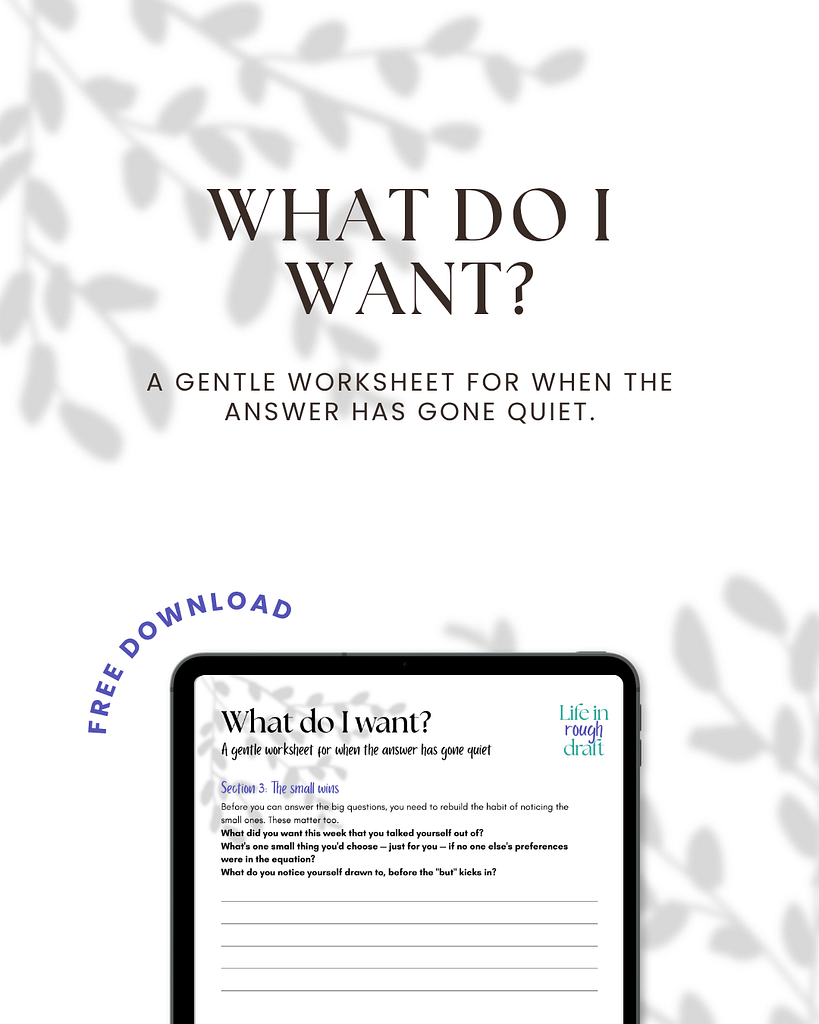
Want to go deeper?
I’ve put together a free companion worksheet to go with this post.
A little space to think, at your own pace.
Subscribe now and also get access to the Freebie Vault
(everything you need to navigate midlife with more clarity and self-compassion)
FAQ: What do I want in midlife?
Why can’t I answer “what do I want” anymore?
Because for many women, the years of building a life around others – partners, children, work, family – quietly crowd out the habit of asking. It’s not that the wanting disappeared. It’s that it got practised out of you, gradually and without drama. The good news is that habits can be rebuilt.
Is it normal to lose your sense of what you want after having children?
Completely. When life shifts from I to we, as it naturally does when you’re raising a family, your own wants often get folded away. Not because anyone asked you to, but because there wasn’t room. Many women find it’s only in their forties, when life quietens slightly, that the question resurfaces with any real force.
What does it mean when you draw a blank on what you want?
It usually means you’ve been oriented outward for a long time. The blank isn’t emptiness, it’s more like a signal. Something that was once fluent has gone rusty from lack of use. Starting small helps: noticing low-stakes preferences, pulling on whatever thread does surface, and asking the question regularly without judging the answer.
How do I figure out what I want in midlife?
Start with whatever surfaces, even if it seems vague or obvious. Then pull the thread. Travel might unpack into curiosity. Quiet might unpack into a need for solitude you haven’t been honouring. The first answer is rarely the whole answer, but it’s always worth following.
Does perimenopause affect knowing what you want?
Yes, and this is not talked about enough. The hormonal shifts of perimenopause can affect motivation, mood, and that sense of being plugged into your own life. The brain is literally being rewired. Some women describe it as a muting of the things that used to feel clear or exciting. If your sense of what you want feels particularly foggy right now, your hormones may be part of that picture, and worth paying attention to.