I thought I was falling apart. Turns out I was being rebuilt.
Midlife can be disorientating. Sometimes you look in the mirror (metaphorically and literally) and think: who is this person, and what has she done with the woman I used to be?
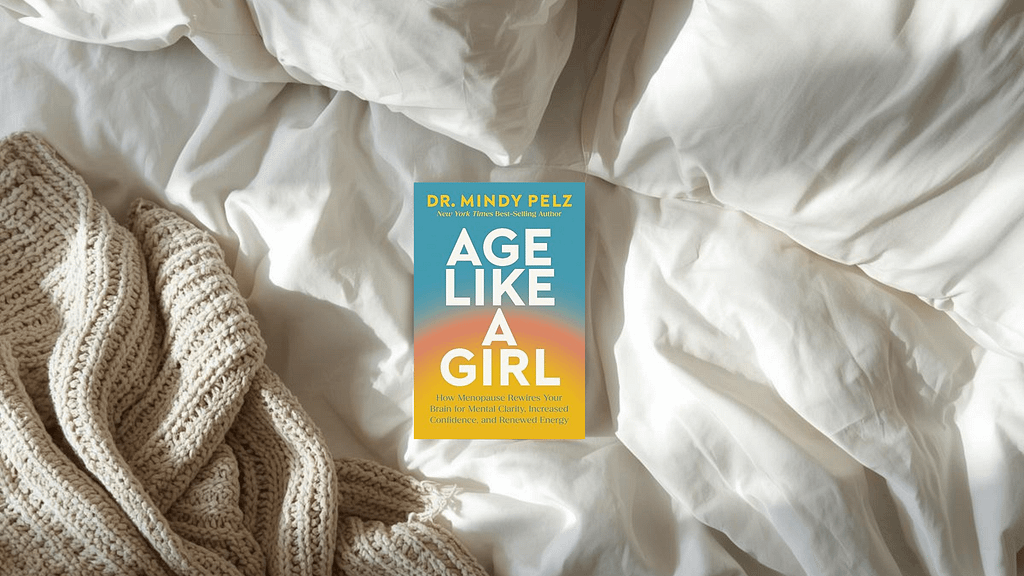
That’s where I was when I picked up Age Like a Girl. Not in crisis exactly, but in that foggy in-between space where things that used to feel easy — clarity, motivation, knowing what I wanted — felt suddenly unreliable. I’d been telling myself it was stress, or sleep, or just the general weight of everything. I hadn’t really considered that my brain might actually be changing.
That’s the reframe Dr Mindy Pelz offers in this book, and honestly? It stopped me in my tracks.
The menopause brain rewiring idea that changed things for me
The central premise of Age Like a Girl is that menopause isn’t a decline; it’s a neurological reset. Your brain is literally rewiring itself. The hormonal shift that causes all those symptoms we dread (the brain fog, the mood swings, the feeling of being a stranger in your own life) is, according to Pelz, the mechanism of a deeper transformation.
She calls it a “butterfly moment.” You’re not breaking, you’re becoming something different.
I’ll be honest — I can sometimes be a little sceptical of that kind of framing. It can tip easily into toxic positivity, the kind that asks you to just reframe your suffering rather than actually address it. But Pelz earns the metaphor. She grounds it in neuroscience, in the biology of what’s actually happening to the brain during perimenopause and beyond, and that made it land differently for me than a lot of wellness writing does.
What shifted for me personally was understanding that some of what I’d been experiencing (the restlessness, the questioning, the feeling that things that used to satisfy me no longer do) might not be something going wrong. It might be my brain clearing space for something more authentic. That’s a genuinely different way of holding the experience, and I’ve found myself returning to it.
What the book covers
Beyond the big reframe, Age Like a Girl gets practical. Pelz walks through how to support your brain and body through this transition using lifestyle tools — nutrition, movement, sleep, stress regulation. She draws on neuroscience, the “Grandmother Hypothesis” (a fascinating lens on why menopause exists at all from an evolutionary standpoint), and her own clinical experience.
There’s real substance here. If you’re someone who wants to understand the why behind what’s happening in your body, not just be handed a list of things to do, you’ll find a lot to sink your teeth into.
The bit that made me want to hand this book to everyone
Here’s what I didn’t expect: two of my favourite sections in this book aren’t written for women at all.
There’s a section for men — partners, sons, colleagues — on how to show up for the women in their lives who are navigating perimenopause and menopause. And there’s a section for employers, making the business case for why losing menopausal women from the workforce is a costly, preventable problem.
I adored both of them. Not because they’re revolutionary in isolation, but because of what their inclusion says about how Pelz sees this conversation. Menopause isn’t a woman’s problem to quietly manage. It’s a family experience. A workplace issue. A societal blind spot that costs us — all of us — when we treat it as something that only happens to women and is therefore only women’s business to deal with.
We all have a part to play in understanding, educating ourselves, and showing up better. The fact that this book makes space for that feels important. If you’re thinking about gifting it, those sections alone make it worth putting in the hands of the people around you, not just reading it yourself.
A few honest caveats
Because we all deserve a real review, not a fan letter:
The fasting protocols weren’t for me. Pelz is a big advocate for intermittent fasting and that comes through strongly in this book (and in her broader body of work). If fasting resonates with you, you’ll find plenty of useful guidance. If it doesn’t, if it feels triggering, overly prescriptive, or just not aligned with how you relate to food, you might find those sections a bit much. I skimmed a few of them. The rest of the book is still worth your time.
It’s quite US-centric. Some of the references, resources, and framing are very much written with an American reader in mind. It’s not a deal-breaker, but worth keeping in mind if you’re coming to it from elsewhere.
She references her other books … a lot. Fast Like a Girl and Eat Like a Girl get mentioned regularly, sometimes in ways that feel more like cross-promotion than necessary context. If you’ve read those already, this won’t bother you. If you haven’t, it can occasionally feel like you’ve walked into the middle of a series.
Who should read Age Like a Girl?
If you’re in perimenopause, menopause, or even just that murky zone where your body and brain feel like they’re shifting in ways you don’t fully understand, this book is worth reading. It’s accessible, it’s science-backed without being dry, and the core reframe is genuinely useful.
Even if you don’t adopt every protocol Pelz recommends (I certainly didn’t), the way she repositions this stage of life as meaningful rather than just difficult is something I think a lot of us need to hear right now.
Age Like a Girl by Dr Mindy Pelz is published by Hay House and available wherever books are sold.
Have you read it? I’d love to know what landed for you. Hit me up on Instagram and let me know.
Before you go …
What are you editing, keeping, releasing or rewriting right now?
Those are the questions I explore in my emails.
If that sounds like a conversation you’d like to be part of, pop your email below and I’ll send occasional notes from the messy middle of adulthood.